Month: August 2026

A warming world: the range expansions of lone star ticks, Amblyomma americanum, and the alpha-gal they carry
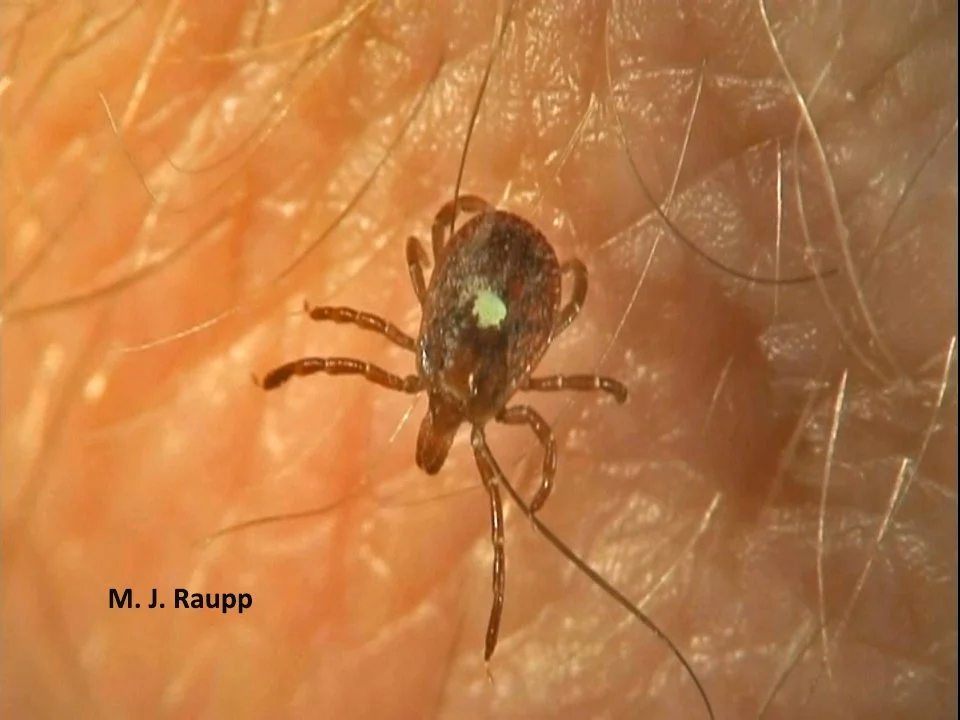
Female lone star ticks are easily identified by the white or off-white spot on the center of their back.

During this tick season, I received several inquiries and answered a slew of questions regarding ticks and why they are so abundant this year. Back in April, PBS warned of the uptick (pun intended) in emergency room visits for tick bites, and recently the New York Times followed up with the headline “The Summer the Ticks Took Over.” My colleague and webmaster suggested that it might be time to revisit a past episode on ticks. So, let’s dig in with a remake about the lone star tick and the nasty red-meat allergy associated with its bite.

First, what’s up with the business of climate change and range expansions of ticks? Ticks and insects are cold-blooded, ruthless maybe, but in the biological sense they are largely dependent on ambient temperatures found in their environment to support physiological processes like growth, development, and movement. During winter’s chill in the Washington DC – metropolitan region, with temperatures in the 30-degree Fahrenheit range, it is simply too cold for ticks to move about seeking blood meals from warm-blooded hosts. As temperatures rise in late winter and spring, ticks awakened from their chilly torpor to quest for the blood of animals. Blood provides the protein and other nutrients necessary for ticks to grow, develop, and reproduce.
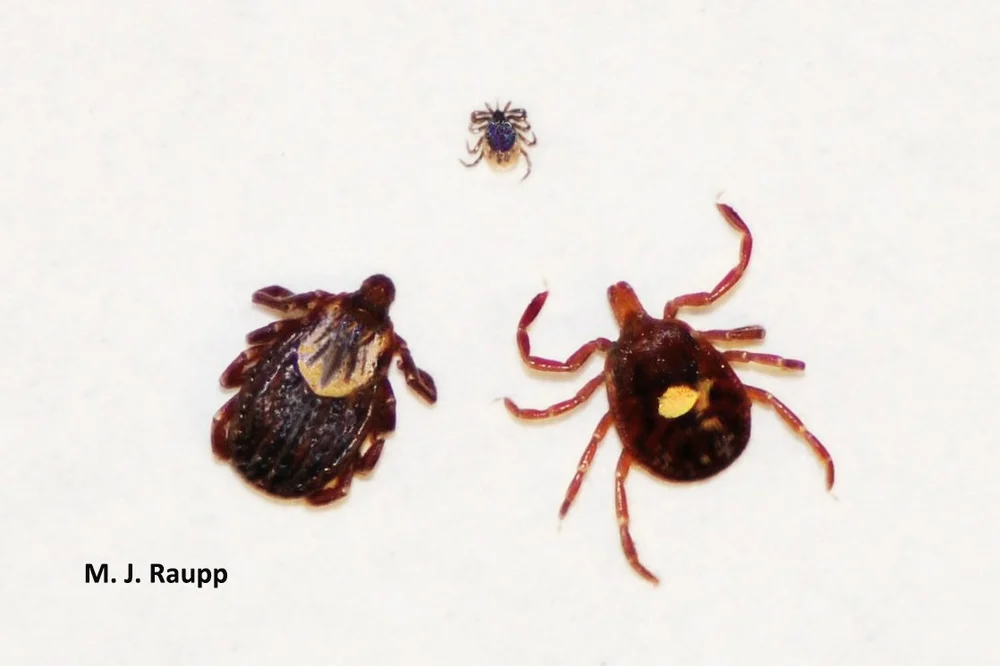
A trio of trouble (clockwise from top): Blacklegged Tick (vector of Lyme and other diseases), Lone Star Tick (vector of alpha-gal and other diseases), American Dog Tick (vector of Rocky Mountain spotted fever and others).   

As our world warms, spring’s warmth arrives earlier and autumn’s glow often lasts well past Thanksgiving here in the DMV. The lengthening of the warm season simply provides ticks with more days to be active and to acquire vital blood meals. More tick days mean more opportunities to be bitten and more chances to contract a tick-borne illness. According to Capital Weather, this summer has been one of the hottest on record for the DMV.

In addition to limiting mobility, cold temperatures can be lethal to ticks, just as they are to other forms of life. A very cool laboratory study by Dr. C. S. Burks and colleagues found that 2 hours of direct exposure to temperatures below 7° Fahrenheit proved lethal to lone star tick immatures (nymphs) and adults. Part of this study, conducted in the winter of 1993-1994, also found that these low temperatures did not occur on the forest floors in Ohio, lucky for those ticks back in the day. Leaf litter on the forest floor and snow cover provide insulation for overwintering ticks, enhancing their survival even on very cold nights. Think back to last winter, 2025-2026, in the DMV. We did have some pretty cold weather through December and February, but that long lingering snow cover provided a moist thermal blanket protecting over-wintering ticks from lethal cold. The large mass of the earth itself provides a thermal refuge for creatures on the ground and just inches below the soil surface.

Historically, the lone star tick is more of a southern tick. However, lone star ticks have expanded their range further northward over the last seven decades from their historical northern limit of Iowa, Illinois, Ohio, West Virginia, Maryland, Delaware, and New Jersey to historically cooler northern realms including Minnesota, Wisconsin, Michigan, Pennsylvania, New York, Connecticut, Massachusetts, Vermont, New Hampshire, and Maine. This pattern is predicted to continue or perhaps accelerate as greenhouse gas emissions continue to trap solar energy and warm our planet. A recent study by Dr. R. K. Raghavan and colleagues suggests that future conditions associated with climate change may make maritime regions of Canada climatically suitable for survival of lone star ticks.
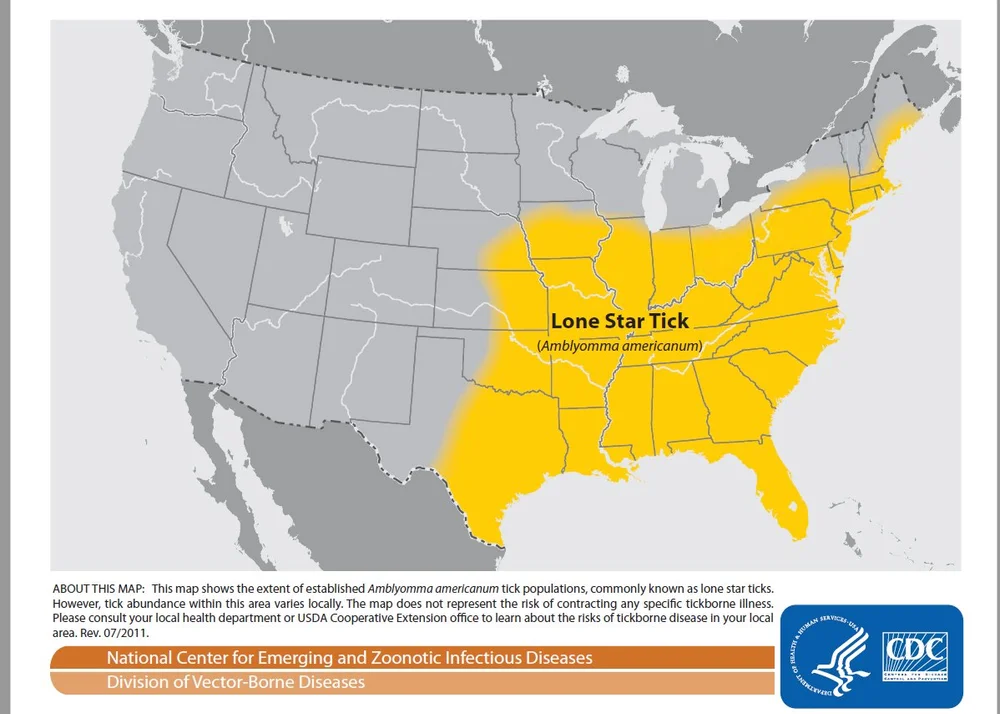
The current range of the lone star tick in the United States has expanded northward in the past century. Image credit: CDC

Accompanying the spread of lone star ticks has been the spread of folks who developed an allergy to eating red meat after being bitten by a lone star tick. Several friends and colleagues developed the red meat allergy known as alpha-gal syndrome after a close encounter with a lone star tick. Let’s dive in and see what this strange sounding syndrome is all about. Alpha-gal syndrome is a human’s immune response to galactose-alpha-1,3-galactose (alpha-gal). Alpha-G is a carbohydrate molecule found on the surface of muscle cells of many types of wild mammals including mice and rabbits, but also on mammals whose flesh we regularly eat like cattle and pigs. When a lone star tick dines on blood of one of these feral or domesticated animals, it ingests the alpha-gal molecule. When the tick feeds again, maybe on you, it injects saliva laced with alpha-gal. Your body’s powerful immune system recognizes this foreign compound and mounts a potent immune response to it.
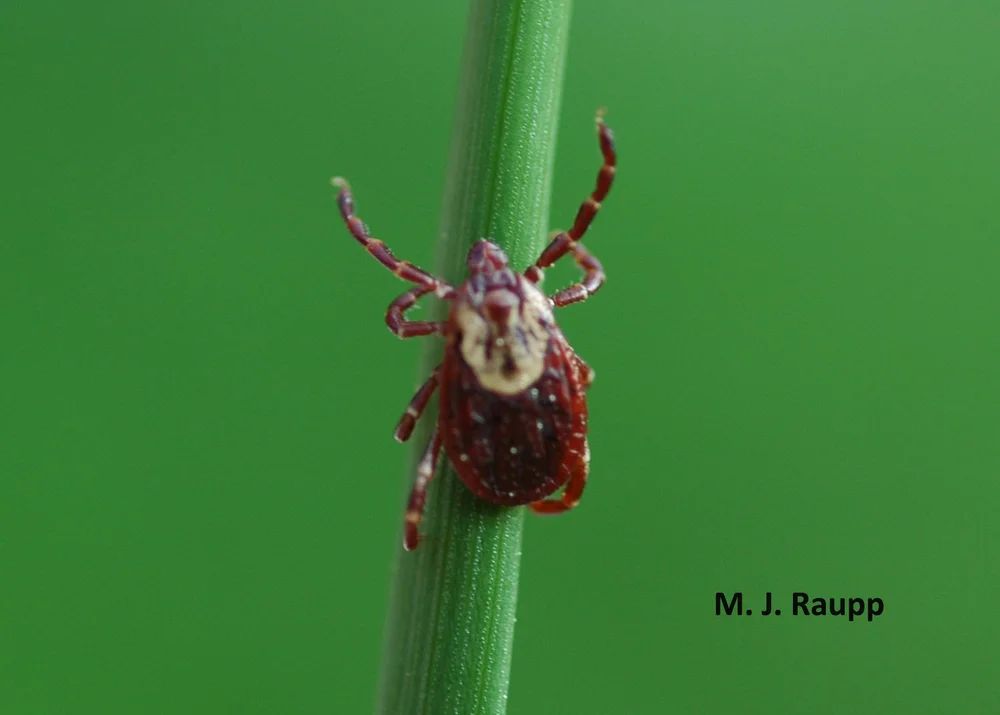
Ticks will climb up vegetation and reach out with forelegs to encounter a host. This behavior is called questing.

The immune system produces a library of cells ready to produce antibodies to attack alpha-gal the next time it enters your body. Unfortunately, this may happen when you bite into a juicy burger or pulled-pork sandwich. This second exposure can trigger an allergic reaction that can cause hives, itching, swelling of the lips, face, tongue and throat, wheezing, shortness of breath, runny nose, sneezing, headache, abdominal pain, diarrhea, nausea or vomiting. In severe cases, a person may suffer anaphylaxis, a potentially fatal allergic reaction. Often the reaction does not occur until several hours after the meal.

Alpha-gal syndrome is found in many parts of the world, including Europe, Asia, and Australia, but it is particularly common in the southeastern United States and now is spreading to other parts of the country. Contracting alpha-gal does not relegate one to a meatless existence. Fish, shellfish, poultry, and other non-mammalian meat sources lack the alpha-gal molecule and may be consumed without fear. A recent study revealed one more piece of disturbing news regarding ticks and alpha-gal. The alpha-gal antigen has also been discovered in the saliva of notorious black-legged ticks, implicating them not only as vectors of Lyme disease, but also as potential culprits in the red-meat allergy. Yikes!

Content to chill out on my arm, a female lone star tick makes a mad dash under the probing lens of the camera. Unfed ticks are wafer thin, but after feeding for several days their body weight may increase 200 times. Female ticks convert protein from the blood meal into thousands of eggs.

Reports indicate that the red-meat allergy may decline in time in some individuals. Does the bite of a lone star tick mean you are doomed to this allergy? Absolutely not. I have been bitten by lone stars on several occasions and still enjoy a burger now and again with no problem. As with other allergies, individual reactions are complex and may differ from one individual to another. In addition to alpha-gal, lone star ticks transmit several other illnesses including Southern Tick Associated Rash Illness (STARI), which has been associated with the bacterium Borrelia lonestari. Symptoms of STARI include rash, fever, fatigue, and pain in muscles and joints. A second disease spread by the lone star tick is ehrlichiosis. Ehrlichia bacteria produce nasty flu-like symptoms including headache, joint ache, fever, fatigue, muscle ache, confusion, and several other disheartening symptoms.

To reduce the risks of becoming a meal for a tick and the unfortunate recipient of alpha-gal, STARI, ehrlichiosis, or other tick-borne illnesses including Lyme disease, remember the acronym “AIRI”. This stands for avoid, inspect, remove, and identify.

“A”Avoid ticks and their bites in the following ways. When taking Fido for a walk, stick to the path, trail, or pavement. You are unlikely to encounter ticks on non-vegetated surfaces. If you enter habitats where wildlife and ticks are likely to be present, such as grassy meadows, borders of fields and woodlands, and vegetation along the banks of streams, wear long pants and light-colored clothing. This will help you spot ticks on your clothes as they move up your body. Be a geek – tuck your pants into your socks, and your shirt into your pants. This forces ticks to move up and over your clothes rather than under them where tasty skin awaits. Apply repellents labeled for use in repelling ticks. Some are applied directly to skin, but others can be applied only to clothing. Don’t forget to treat your footwear, socks, and pant legs. Immature ticks called nymphs are a key vector of diseases and these precautions will help prevent nymphs and adults from attaching to your skin. If repellents are used, be sure to read the label, follow directions carefully, and heed precautions, particularly those related to children. If your adventures take you into tick territory, consider placing your clothes directly into a clothes dryer rather than a hamper upon returning home. The heat of the dryer will kill hitchhiking ticks that might otherwise escape clothes in the hamper and cause trouble after your return home.

“I”Inspect yourself, your family, and your pets thoroughly if you have been in tick habitats. Remember to do this when you return from the outdoors and when taking a shower. A thorough inspection may involve enlisting a helper to view those “hard to see” areas around back.

“R”Remove ticks promptly if you find them. Removal within the first 24 hours can greatly decrease your risk of contracting a disease. While this holds for microbial disease agents like bacteria and protozoans, unfortunately, the sugar molecule that causes alpha-gal may transfer from tick to human shortly after the tick begins to feed. If you find a tick attached, firmly grasp the tick as close to your skin as possible using a pair of fine forceps and slowly, steadily pull the tick out. Cleanse the area with antiseptic. The CDC and the Bug Guy do not recommend methods of tick removal such as smearing the tick with petroleum jelly or scorching its rear end with a match. Cases of some tick-borne diseases such as Lyme disease are the most common in children and seniors, so take special care to keep kids of all ages safe when they play outdoors.

“I”Identify your tick, don’t toss it out or flush it down the toilet. If you discover a tick that has imbedded in your skin, you should determine its identity and discover what disease organisms it might harbor. There are several tick testing services that will identify the tick and perform molecular analysis to determine several important disease agents it may be carrying. On a recent encounter with a tick, after removing a lone star from my waist, I sent it off to a tick-testing laboratory. Within a week, I had results and this little rascal tested negative for the causal agents of Lyme disease, relapsing fever, anaplasmosis, Rocky Mountain spotted fever, Pacific Coast tick fever, tularemia, and ehrlichiosis. Lucky me. If you find an embedded and engorged tick, please send it to a tick-testing lab. If it tests positive for one or more tick borne diseases, consult your physician and develop an action plan. Several tick testing services can be found on the internet by simply googling “Tick Testing Services”. They provide step by step directions to prepare your sample for analysis and where to send it.
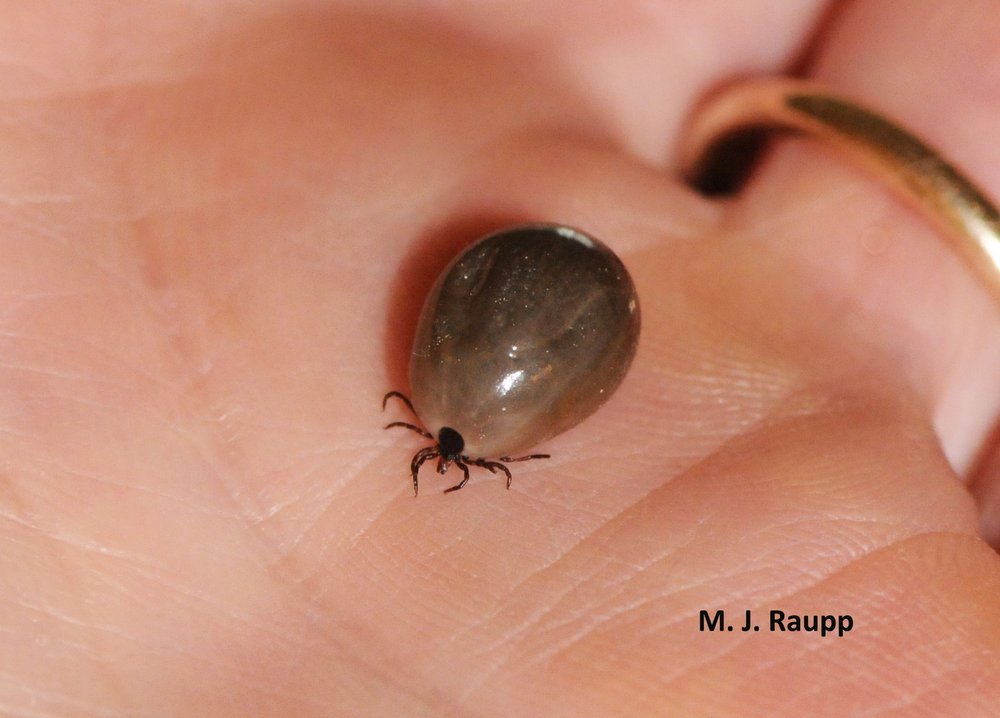
Fully engorged ticks are enormous. After feeding for many days, an engorged tick may have increased its body weight 200 times.

Reducing Tick Numbers in the Landscape

Around the home, reduce habitat for small mammals that serve as the blood meal for ticks and the source of disease-causing bacteria. Remove piles of brush, unstacked wood, and rubbish that serve as a refuge for rodents and other small mammals. Mow and remove unkempt grasses, weeds, and other vegetation at the edge of the lawn. Mulch beds that border the transition zone between lawn and forest edge. By opening these areas, raptors and other predators may more easily spot and remove small mammals. Design patios and play areas for children away from forest edges where ticks are more likely to be found. If you follow these precautions, you can reduce the risk of encountering ticks and associated illnesses, while still enjoying the great outdoors.

You might also consider placing tick tubes in your landscape to help reduce densities of ticks associated with mice. Tick tubes are small tubes akin to those used for paper towels. Tubes containing permethrin-treated cotton are placed in the landscape. Mice collect pesticide-laced cotton to build their nests. Ticks attached to the mice are exposed to permethrin and killed thereby reducing the population of ticks and hopefully, reducing the incidence of tick-borne illnesses. Efficacy and deployment of tick tubes are discussed in an interesting study conducted by scientists at Penn State and the University of Florida.  

Acknowledgements

Bug of the Week thanks Chris Sargent, Kevin Chase, Bill Gimpel, Kevin Ambrose, Livia Albeck-Ripka, and the Four Seasons Garden Club for providing inspiration for this episode. The fascinating articles “Current and Future Distribution of the Lone Star Tick, Amblyomma americanum (L.) (Acari: Ixodidae) in North America” by Ram K. Raghavan, A. Townsend Peterson, Marlon E. Cobos, Roman Ganta, and Des Foley, “ Range Expansion of Tick Disease Vectors in North America: Implications for Spread of Tick-Borne Disease” by Daniel E. Sonenshine, “Population and Evolutionary Genomics of Amblyomma americanum, an Expanding Arthropod Disease Vector” by Javier D. Monzo´n, Elizabeth G. Atkinson, Brenna M. Henn, and Jorge L. Benach, “The role of direct chilling injury and inoculative freezing in cold tolerance of Amblyomma americanum, Dermacentor variabilis and lxodes scapularis” by C. S. Burks, R. L. Stewart, G. N. Needham, and R. E. Lee, “Discovery of Alpha-Gal-Containing Antigens in North American Tick Species Believed to Induce Red Meat Allergy” by Gary Crispell, Scott P. Commins, Stephanie A. Archer-Hartman, Shailesh Choudhary, Guha Dharmarajan, Parastoo Azadi and Shahid Karim, and “Maximizing and sustaining the efficacy of tick tubes for management of Ixodes scapularis through optimized deployment strategies” by Hannah S Tiffin , Kylie D Green , Edwin R Burgess, IV , and Erika T Machtinger, were used to prepare this episode.

To read more on the Alpha-gal allergy, check out this recent Washington Post article: https://www.yahoo.com/lifestyle/tick-makes-people-allergic-red-171750634.html  

To read more about the range expansion of lone star tick, please click on this link to the New York Times: https://www.nytimes.com/2022/05/13/us/lone-star-tick-bite-meat-allergy.html

For information on Tick Identification in Maryland, click on: https://health.maryland.gov/phpa/OIDEOR/CZVBD/Pages/Tick-Identification.aspx 

This post appeared first on Bug of the Week
Horntails and Lanternflies hammer invasive Tree of Heaven (Ailanthus altisima): Spotted lanternflies, Lycorma delicatula, and the Pigeon tremex, Tremex columba

Spotted lanternflies and horntail wood wasps conspire to remove invasive Tree of Heaven from landscapes in the DMV and elsewhere.

Tree of Heaven (TOH) was imported to North America by an avid gardener in Philadelphia, PA in 1784, a time when importing exotic plants from around the world to grace gardens and landscapes was the thing to do. Human-assisted spread of TOH continued into the 1850s, when TOH were transported to Western states. While originally planted for its uncanny ability to thrive in highly disturbed locations and poor soils, its ability to displace native vegetation and to serve as a factory for invasive pests, including spotted lanternflies, has earned it a place on the “trees I don’t want in my landscape” list.

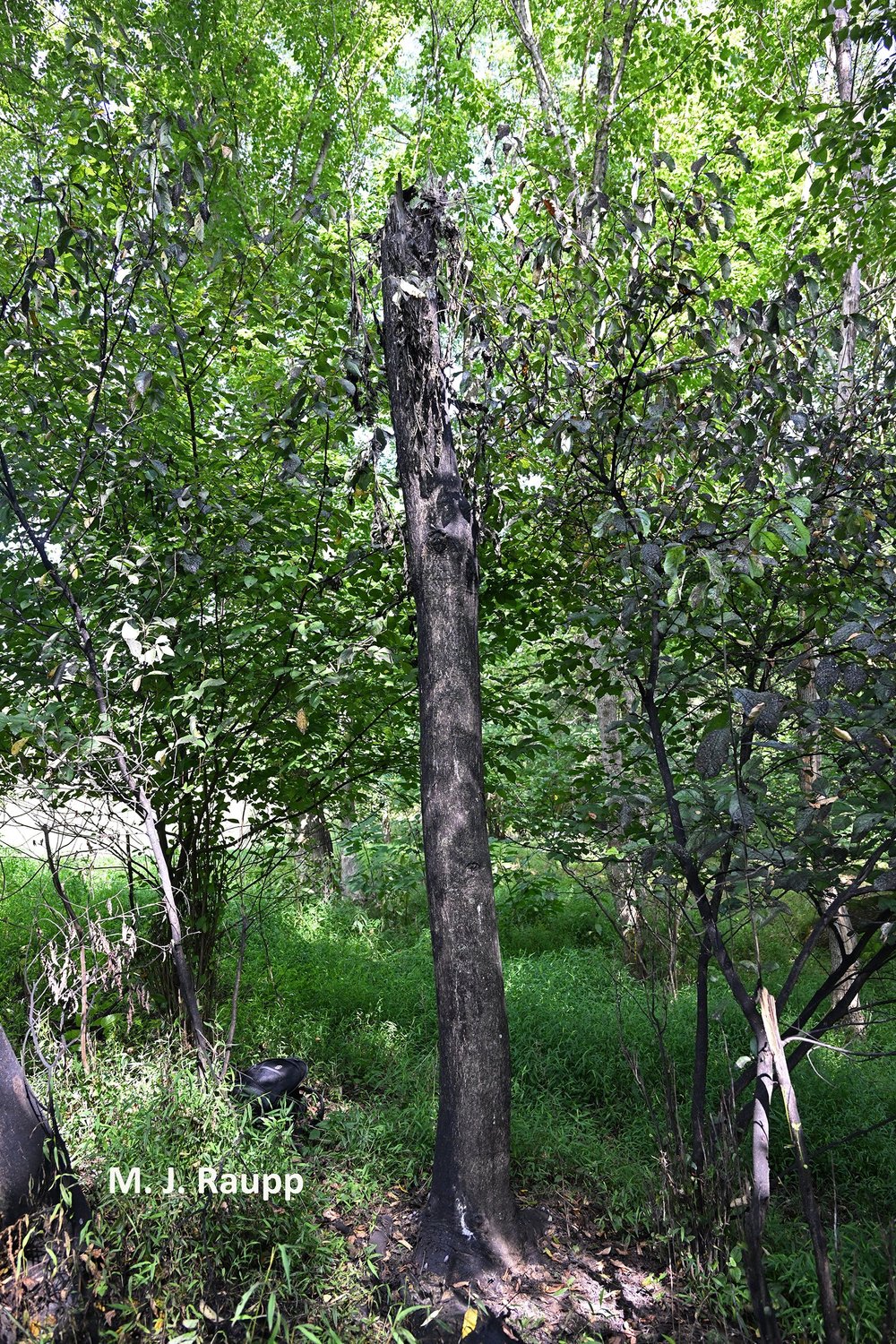
This Tree of Heaven succumbed to the combined attack of lanternflies, wood-boring insects, pathogens, and, perhaps, other non-living stressors of the environment.

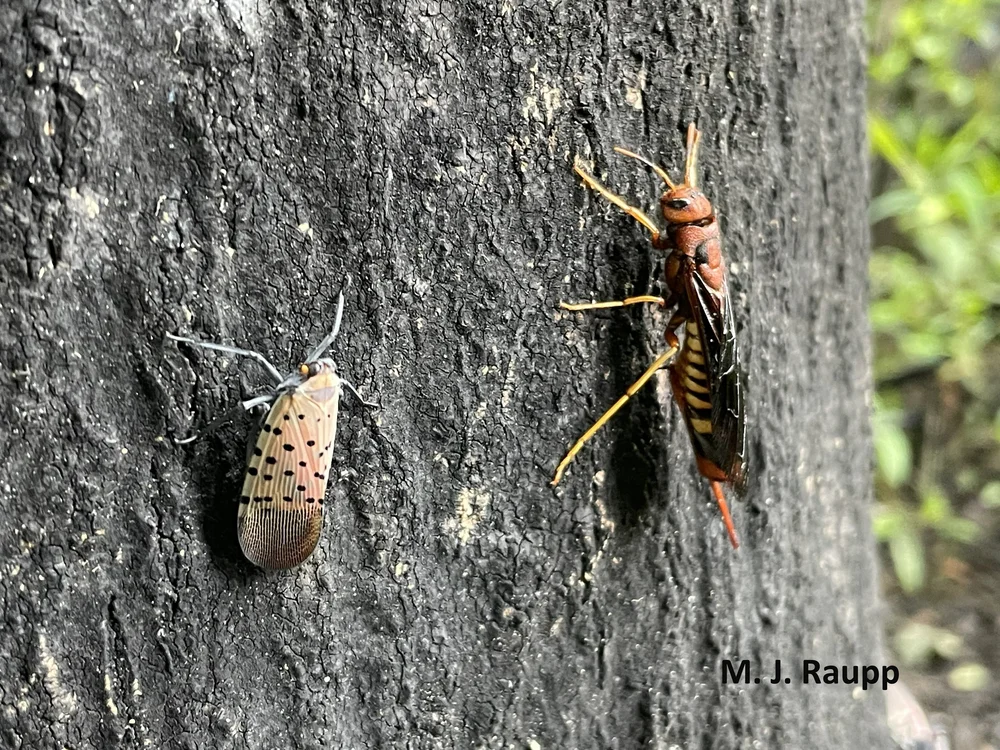
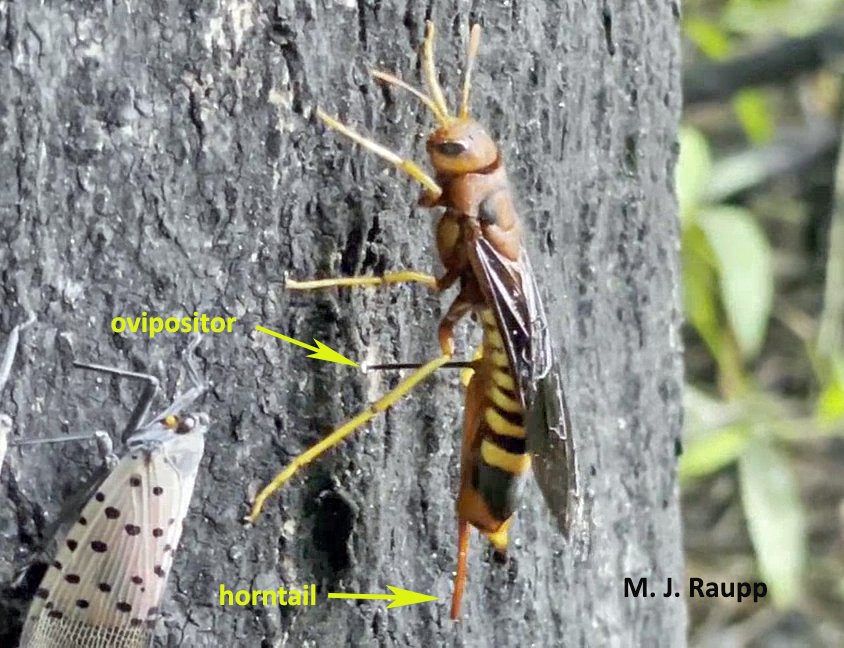
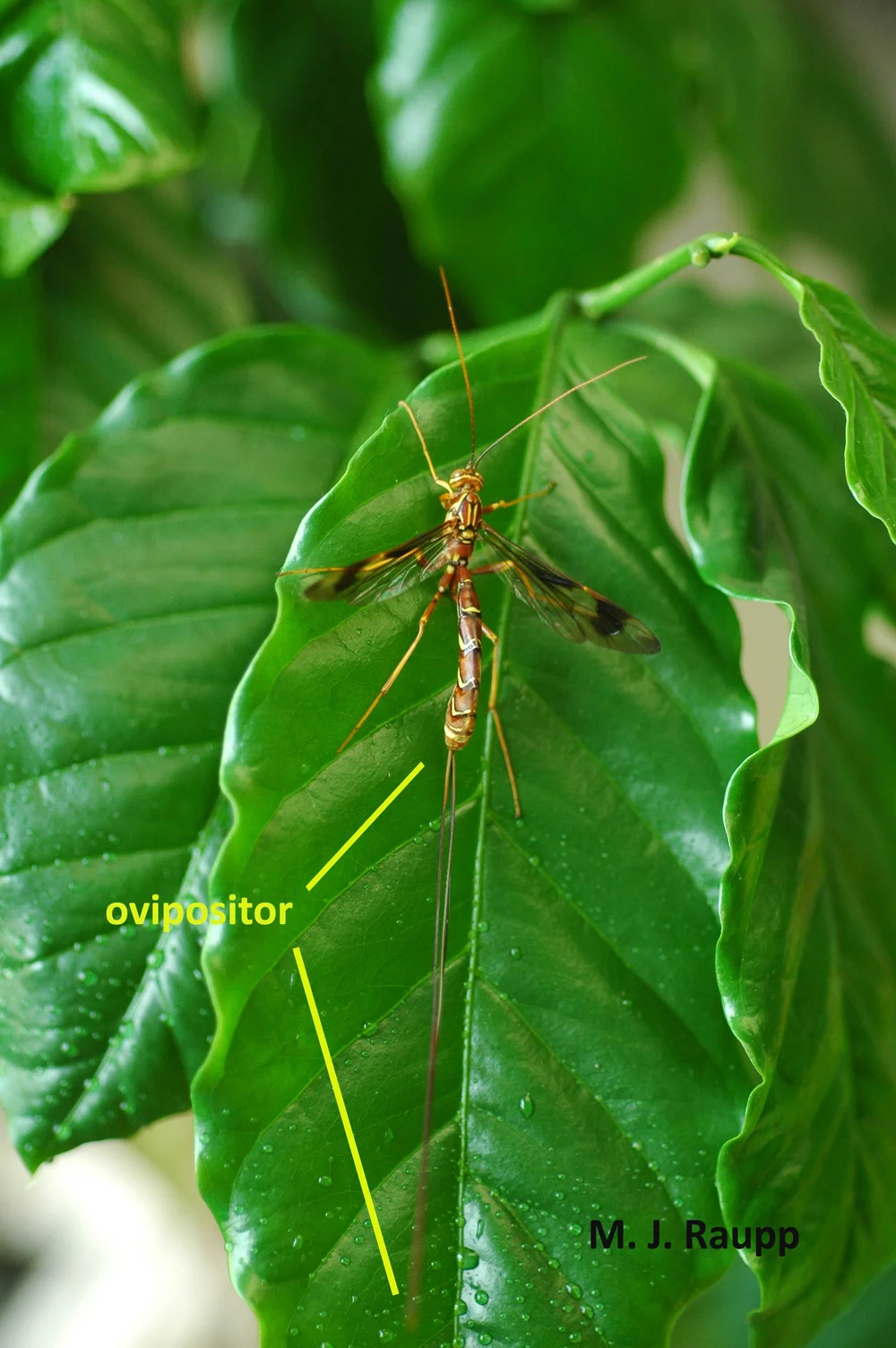
In a previous episode, we met the ailanthus webworm, a native moth whose caterpillars feed on the foliage of TOH and contribute to its demise. We also learned that chronic, high-density infestations by lanternflies rob TOH of vital nutrients, and this combined with other factors may lead to the death of TOH. Last week while visiting a Forest Retention Area heavily infested with TOH and spotted lanternflies, I stumbled across a TOH tumbling down the death spiral with hordes of lanternflies sucking its vital sap and a thinning canopy dropping dead branches. Newly arrived at the bole of the tree was a spectacularly large, colorful wasp called the pigeon tremex. She was thoroughly engaged in depositing her eggs into the dying TOH. The pigeon tremex, a.k.a. pigeon horntail, is part of the wood wasp clan known as Siricidae. Adults of this species have a hornlike appendage at the tip of their abdomen giving rise to the moniker “horntail”. The female wasp seeks dying or freshly dead trees as a nursery for her young. The female uses an exquisitely long egg-laying tube called an ovipositor to drill into the bole of the tree and deposit her eggs.

It’s easy to see why the pigeon tremex is called a horntail. The female’s powerful ovipositor drills deep into a tree to lay eggs. After hatching, her wood-boring larvae hasten the demise of the tree.

Along with the eggs, wood wasps introduce fungi into the wound. These fungi help digest recalcitrant woody tissues that serve as the food for developing wasp larvae. Larvae devour the woody tissues and are easily recognized by a characteristic spiny appendage on their rear end. Feeding by wasp larvae reduces the structural integrity of the tree, further hastening its collapse.  Reports abound that the pigeon tremex often dies with her ovipositor still inserted into the bark of the tree. However, an inspection of the tree the following day provided no evidence that this wasp perished following the act of laying her eggs. Perhaps, she lived to lay another day or disappeared down the gullet of a hungry bird. Who knows?

Chronically high densities of spotted lanternflies like these weaken invasive Tree of Heaven (TOH) and may usher them along a spiral of decline leading to death. Dying and dead deciduous trees including TOH attract a spectacularly large, colorful wasp called the pigeon tremex. Adults of this species have a hornlike appendage at the tip of their abdomen giving rise to the name “horntail”. Watch as the female uses a long egg-laying tube called an ovipositor to drill into the bole of the tree, where she deposits eggs. When eggs hatch, with assistance from fungi introduced by the wasp, her larvae devour the woody tissues of the tree, reducing its structural integrity and hastening its collapse. Wood wasp larvae are important recyclers of dead and dying trees.

Sadly, not all is well for the helpful larvae of the pigeon tremex. They are hunted by a colorful parasitic wasp called the long-tailed giant ichneumonid wasp, Megarhyssa macrurus. This clever parasitoid lands on the surface of a tree wherein larvae of the pigeon tremex develop. Using a combination of cues, she tracks down the precise location of the tremex larva, drills though the wood, stings and paralyses the tremex larvae, and deposits an egg which will hatch into a hungry larva that devours the offspring of the wood wasp. In a bug eats bug world the twists of fate blur the distinction between which bugs are helpful and those that are not.

Beautiful female long-tailed Megarhyssa wasps use their supper long ovipositors to deposit eggs deep inside a tree where larvae of the pigeon tremex feed. Larvae of the tremex will become food for developing Megarhyssa larvae.

Acknowledgements

These fascinating articles were used to prepare this weeks episode:  “Tree-of-Heaven” by David R. Jackson, Art Gover, and Sarah Wurzbacher, “Spotted Lanternfly Frequently Asked Questions” by Heather Leach, “Pigeon Tremex” by James Baker, “Symbiotic relationship between Cerrena unicolor and the horntail Tremex fuscicornis recorded in the Czech Republic” by SYLVIE PAŽOUTOVÁ and PETR ŠRŮTKA, and “Megarhyssa spp., The Giant Ichneumons (Hymenoptera: Ichneumonidae)” by Ilgoo Kang, and Christopher Carlton.

This post appeared first on Bug of the Week
Serving a watery eviction notice to common paper wasps, Polistes exclamans

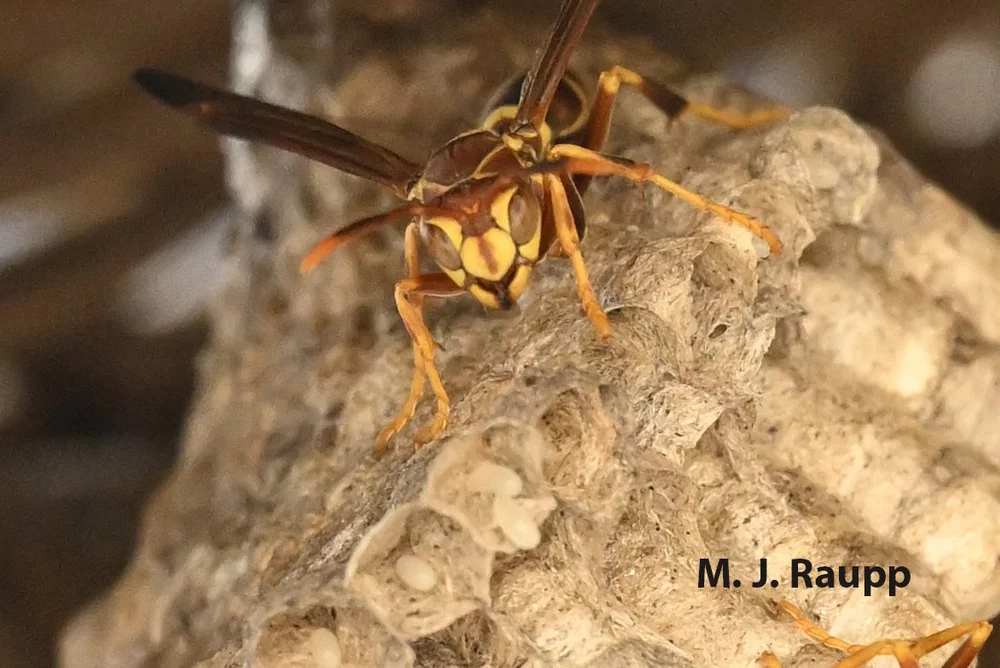
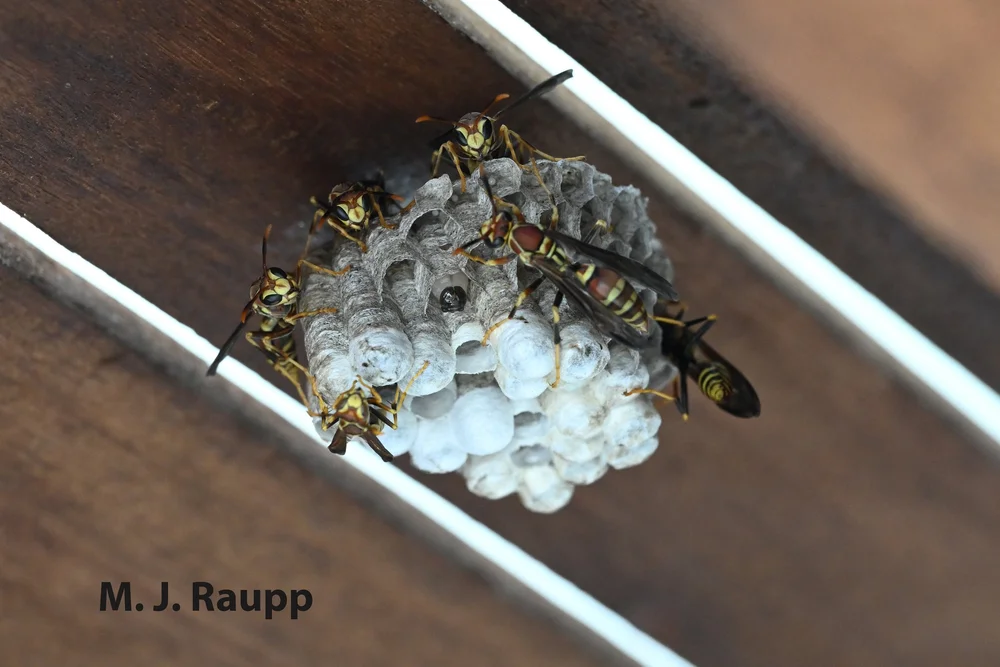
Beneath a picnic table, fierce paper wasps are on guard and ready to defend their nest.

Subscribers to Bug of the Week have noted the somewhat perplexing juxtaposition in the viewpoint of this blog. Sometimes we advise extreme prejudice against bugs like mosquitos and bed bugs, and sometimes we advocate benevolent treatment for insects like Monarch butterflies and solitary bees. This week we do a little of both with paper wasps, Polistes spp. Many of us have had the enlightening experience of coming just a bit too close to a paper wasp nest and being rewarded with a memorable sting. This happened to me recently as I tried to move two pieces of patio furniture and was surprised by the sting of a paper wasp intent on protecting her nest, which was nestled beneath the arm of a chair.

“Come one step closer to these eggs and I will teach you a lesson!”

While nests are typically located beneath overhangs of houses, sheds, or entryways of homes, virtually any horizontal surface shielded from rain can be a nesting site. In temperate regions like the DMV, in early spring nests are initiated by a female wasp called a foundress. The foundress survived the wicked winter in a sheltered spot, perhaps beneath the bark of a tree or behind a loose piece of siding on a home. The foundress uses her powerful jaws to gather wood fiber from trees and shrubs. She chews the fiber into pulp and molds the pulp into papery cells. The ever-enlarging nest is shaped like a parasol and suspended by a narrow stalk called a pedicel. After the first few hexagonal cells are constructed, the foundress deposits an egg within each chamber.

While rearranging some patio furniture, a paper wasp delivered an unexpected sting when I moved a chair. Beneath the arm of the chair, two fierce females were ready to defend their small nest. Nearby, under a picnic table, a larger nest was guarded by several wasps. In another video, watch how I evict these paper wasps from my furniture and house without the use of insecticides.

Eggs soon hatch into legless larvae. Her youngsters have healthy appetites, and the queen gets busy hunting food for her babes. Not all potential foundresses are successful in establishing a colony. Some may join an established nest where they assist the resident foundress in caring for the brood. The colony grows as summer progresses and more than a hundred workers may be produced in some species of paper wasps. Caterpillars are one of the favorite menu items for larvae of paper wasps, and in this way paper wasps are our allies in the fight against leaf-munching garden pests. By capturing droves of caterpillars, paper wasps reduce damage to our valuable crops and landscape plants. In addition to eating pests, paper wasps provide a second ecosystem service by pollinating plants. I often see them visiting mountain mints in my garden and goldenrods in the meadow.

Enough of the goodness of paper wasps. Let’s talk about what you can do at this time of year if you discover paper wasp nests in your patio furniture or under the roof of your porch. There are several commercial wasp sprays that will kill resident paper wasps and their youngsters developing in the papery nest. If you are allergic to stings of bees or wasps, or if you are simply fearful of wasps and their stings, wasp sprays may be a good option. You could, of course, employ an exterminator to get the job done. Due to their service roles as pollinators and biological control agents, I chose not to employ the insecticide route. Instead, I simply deliver a watery eviction notice to the wasps and encourage them to build their nests elsewhere.

Due to their service roles as pollinators and biological control agents, I chose not to employ the insecticide route. Instead, I simply deliver a watery eviction notice to the wasps and encourage them to build their nests elsewhere. I use a high-powered stream of water from a garden hose to displace the wasps. While they are floundering in disarray or have vacated the premises, I simply remove the nest and toss it on the lawn where fierce, hungry predators will dine on the eggs and developing larvae. Often a single watery eviction will suffice, but sometimes wasps will return and try again to build a nest. After another episode or two of a watery eviction, wasps seek other places to build their nests.

In a previous episode, I recommended simply knocking the nest down with a broom very early in season when but a single wasp or two was present. But by late summer, several aggressive females are present and ready to defend the nest. Instead of a broom, I use a high-powered stream of water from a garden hose to displace the wasps. While they are floundering in disarray or have vacated the premises, I simply remove the nest and toss it on the lawn where fierce, hungry predators will dine on the eggs and developing larvae. Often a single watery eviction will suffice, but sometimes wasps will return and try again to build a nest. After another episode or two of a watery eviction, wasps seek other places to build their nests. This mode of displacement allows the foundress and other wasps to continue their service as pollinators and assassins of pests and live to start another nest or perhaps join a different colony. So, maybe have a look beneath overhangs, in the carport, or at the entryway to your home and eliminate a potential problem now. If you discover a nest out by the barn or in another less worrisome place, maybe watch at a distance the antics of these interesting beneficial insects.

Acknowledgements

Two marvelous references, “The Insect Societies” by E.O. Wilson and “Biological studies of Polistes in North Carolina (Hymenoptera: Vespidae)” by R.L. Rabb, were used in the preparation of this episode. We thank Anne and Jim for providing inspiration for this episode.

This post appeared first on Bug of the Week
Plants as camouflage, who thought of it first? Meet the camouflaged looper, Synchlora aerata

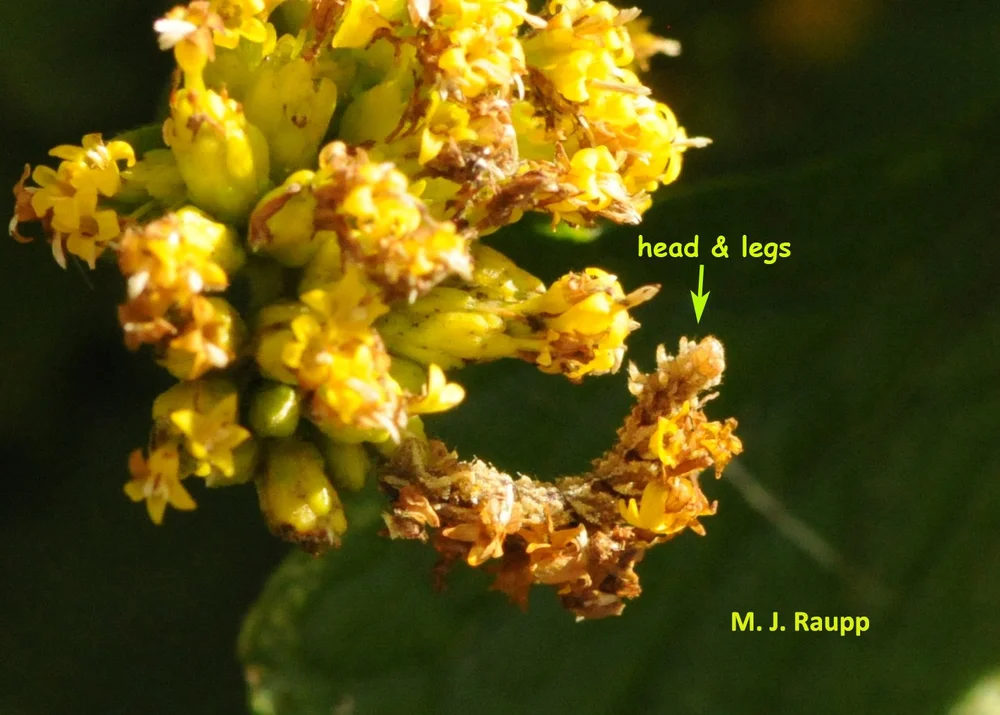
Part of the flower? Not really. A camouflaged looper caterpillar pretends to be florets of a goldenrod blossom.

Movie aficionados may have seen Mark Wahlberg in “Shooter”, a warrior who dons a “ghillie suit.” The ghillie suit incorporates leaves and branches into a camouflaged garment to hide a person from an enemy. Next time you see something like this, just remember that several million years ago a caterpillar thought of it first.  Here’s the backstory. One morning last week as I enjoyed the pollinators in my front flower bed while sipping my morning joe, I noticed a cluster of withered flower petals swaying on a spent flowerhead of a wild bergamot. While this would have meant nothing on a breezy day, it was a puzzle on that still morning.

A ghillie suit of withered burgamot flower petals hides a camouflaged looper within.

A closer inspection revealed that beneath the vegetation, a surprisingly handsome caterpillar wearing a ghillie suit was responsible for animating the withered blossoms. This little trickster was the camouflaged looper, Synchlora aerata. Bedecked with bits of foliage and flower petals, it is sometimes detected when performing a herky-jerky waltz as it moves from one meal to the next. If you have the good fortune to find one, take a moment to sit and watch a stellar performance as the looper sways back and forth, adding to the illusion of a plant part being blown by the wind.

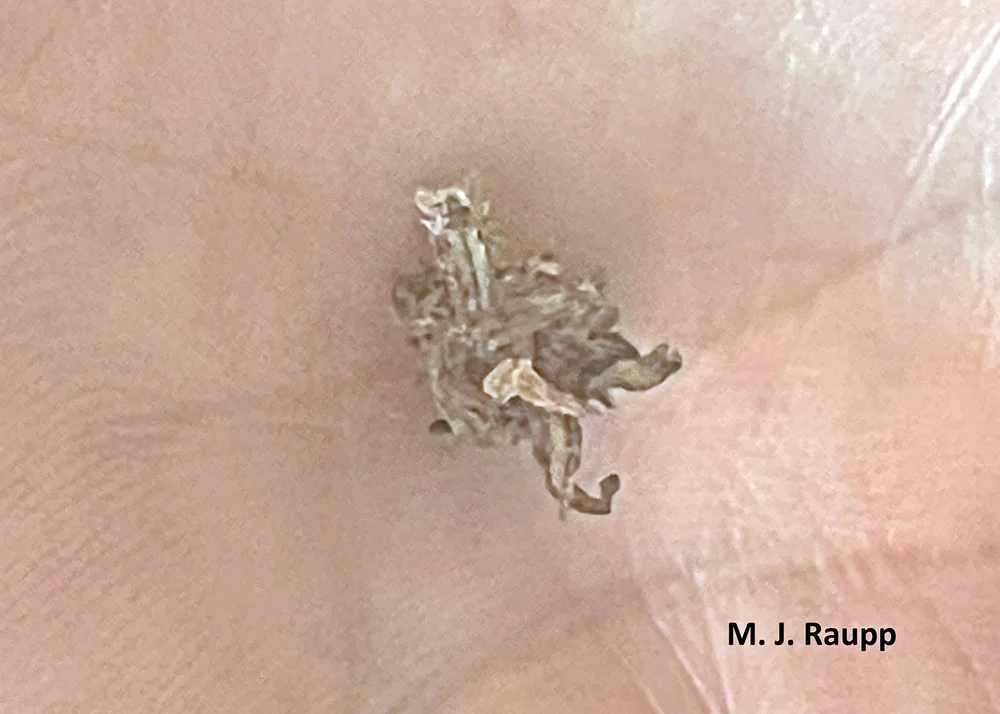
Last week while sipping my morning coffee, I noticed some withered vegetation swaying on a spent flowerhead of wild bergamot on a windless day. When transferred to the siding of the house, this faded foliage revealed itself as camouflaged looper caterpillar. Its superpower lies in its ability to disguise itself using leaves and petals of the flowers on which it feeds. When dining on fading bergamot, browns and grays seem the smart camouflage choice. But when crimson mums are on the menu, it’s better to go with the crimson petals. And when you depart for the next meal add a little “I’m just a petal swaying in the breeze” to your routine just to fool the hungry eyes of predators. Adults of these tricksters are the lovely geometrid moth called the wavy-lined emerald. As autumn approaches, have fun searching for these cool caterpillars in the flower garden or meadow.

Loopers are members of a large family of moths known as geometrids. The name geometrid stems from Greek roots meaning ‘earth measure’. Another common name for some geometrid caterpillars is inchworms. As they cruise about the blossoms, loopers and inchworms do appear to measure the earth inch by inch. In addition to my chrysanthemums, camouflaged loopers eat many types of flowers including ageratum, aster, black-eyed Susan, boneset, coreopsis, daisy, goldenrod, Joe Pye weed, ragweed, raspberry, rose, sage, St. John’s wort, and yarrow. The adult stage of the camouflaged looper is a moth known as the wavy-lined emerald and it is every bit as beautiful as the larva.

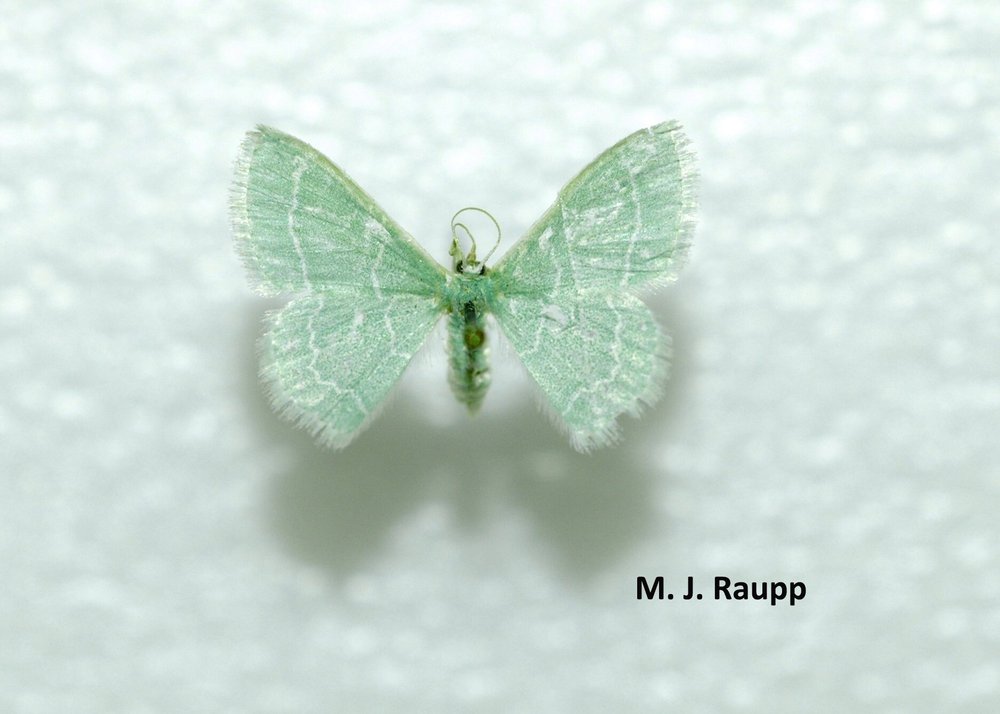
The camouflaged looper turns into a pretty, wavy-lined emerald moth.

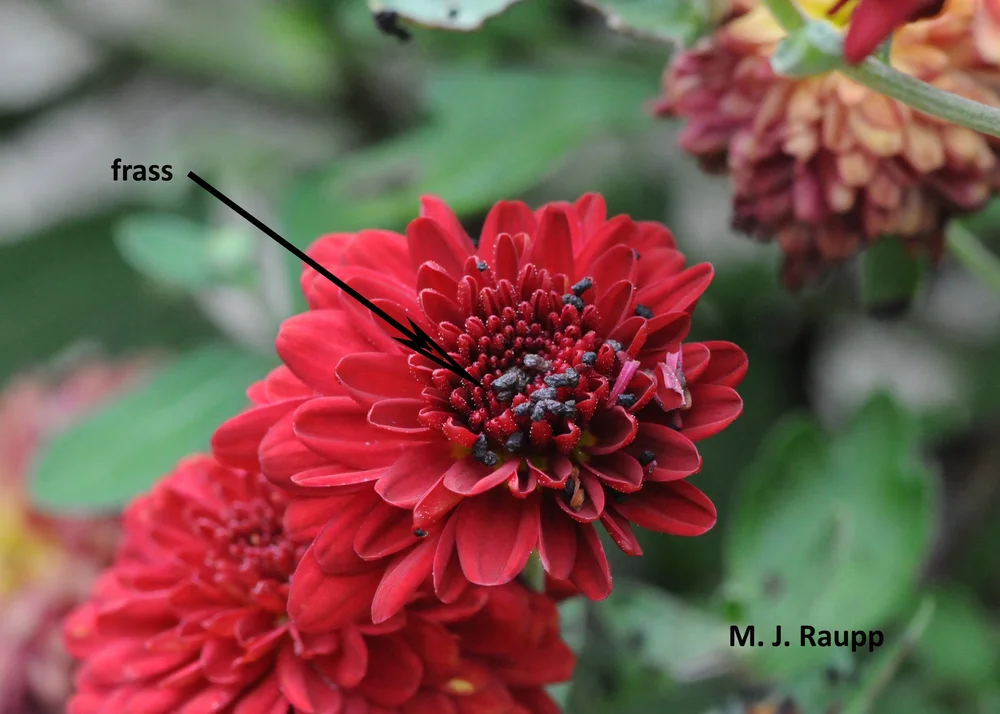
A few years back, while working pulling weeds in a bed of chrysanthemums, I noticed a liberal sprinkling of caterpillar frass decorating blossoms of several plants. Frass, the euphemistic term for the pellet-like, powdery, or sawdust-like excrement of herbivorous insects, often provides a clue, alerting one to the presence of an insect on or in a plant. A thorough inspection of my mums failed to disclose the culprit, but as I watched the plant over a leisurely cup of coffee, I noticed a small cluster of flowery debris swaying on a blossom. A closer inspection revealed a cleverly disguised camouflaged looper cloaked in purple petals busily dining on the flower head. In years past, several eagle-eyed naturalists reported similar sightings on mints and Joe Pye weeds in gardens and meadows as summer turns into autumn. So next time you see some unexpected frass on your flower blossoms or a small cluster of vegetation swaying in the wind, take a few moments to observe your flowers with an eye out for these masters of disguise.

A blossom full of frass is a pretty good clue that a caterpillar may be lurking nearby. This frass was produced by a camouflaged looper feeding nearby.

Acknowledgements

Many thanks to our observant naturalists who discovered camouflaged loopers in their landscape, especially Mara McCall and Glen Schulze, for providing the inspiration for this episode. The wonderful reference “Caterpillars of Eastern North America” by David Wagner was used as a reference for this Bug of the Week.

This post appeared first on Bug of the Week
Don’t let mosquitoes bite: Northern House mosquito, Culex pipiens, and Asian Tiger mosquito, Aedes albopictus

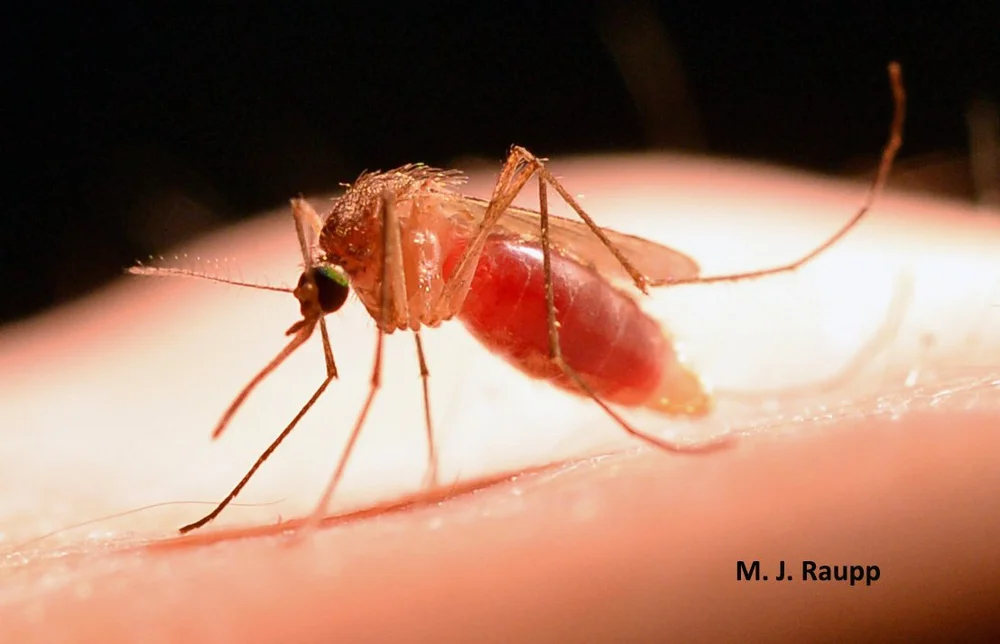
Hungry Northern House mosquitoes, vectors of West Nile virus, are thriving and on the hunt for blood.

As we enter the month of August, it’s high time to protect yourself from mosquito borne illnesses like West Nile Virus. In mid-July a local news agency reported the detection of West Nile Virus in mosquitoes in two counties of central Maryland. Although no human cases were detected at that time, as of the third week of July, the Centers for Disease Control (CDC) reported more than 90 cases of human disease in 20 states with Arizona and Texas leading the way. As record heat continues in our land, generation times shrink for mosquitoes. More mosquitoes are produced in shorter periods of time. Also linked to global warming is the fact that like many insects, mosquitoes become active earlier in the year and their activity continues later in the year. Scientists found that between 1979 and 2022 in cities throughout the United States higher temperatures have greatly increased the number of days each year that are warm enough for mosquitoes to bite. In San Francisco, California, the number of “biting days” has increased by 43 days since 1979. As the tropical storm season ramps up, drenching storm systems create abundant breeding sites for aquatic mosquito larvae. Together, heat and rainfall provide the perfect storm for elevating populations of mosquitoes in many parts of our nation. Let’s learn a little more about mosquitoes, the risks they pose, and how to avoid their bites and the illnesses they carry. The following is revised from a previous episode of Bug of the Week.

Not much to say about this video. Watch as a female Culex pipiens form molestus extracts all the blood she needs to produce the next batch of eggs and then scurries away to the shadow of a knuckle to hide. Filmed at twice life speed.

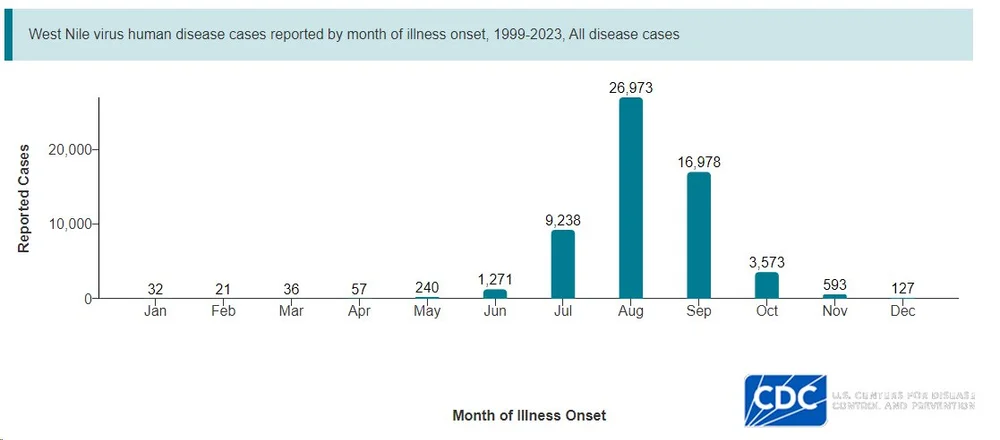
“Mosquitoes are more than just a nuisance and several species carry important diseases such as West Nile Virus. According to the CDC, following its discovery in the United States in 1999, more than 63,000 cases of West Nile Virus have been reported and more than 3,300 deaths associated with West Nile Virus have occurred. While most of us shrug off West Nile virus with little or no symptoms, it can be severe and lethal to seniors and certain others. Researchers have suggested that some seniors and people with compromised immune systems may lack sufficient immune responses to thwart the West Nile Virus.

Historically, August is the most common month to contract West Nile Virus. Image courtesy of Centers for Disease Control

Many species of mosquitoes prefer to feed at dusk, and you can avoid being bitten by staying indoors in the evening. Unlike many of our native mosquitoes, the exotic Asian Tiger is a daytime biter, adding hours of itching, scratching, and swatting to days in the garden. Protect yourself from aggressive biters by wearing lightweight, long-sleeved shirts and pants when working outdoors. Certain brands of clothing are pretreated with mosquito repellents such as permethrin. I wore these clothes in tropical rainforests where mosquitoes were ferocious and they really did help. Many topical insect repellents can be applied to exposed skin before you go outdoors. Some will provide many hours of protection, while others provide virtually none. Some repellents should not be applied to children, and you should always help kids apply repellents. Do not apply repellents containing DEET under clothing. To learn more about mosquito repellents, click here to see repellents recommended by the Centers for Disease Control. For safety, be sure to read and follow the directions on the label of the repellent before you apply it to people or clothing.

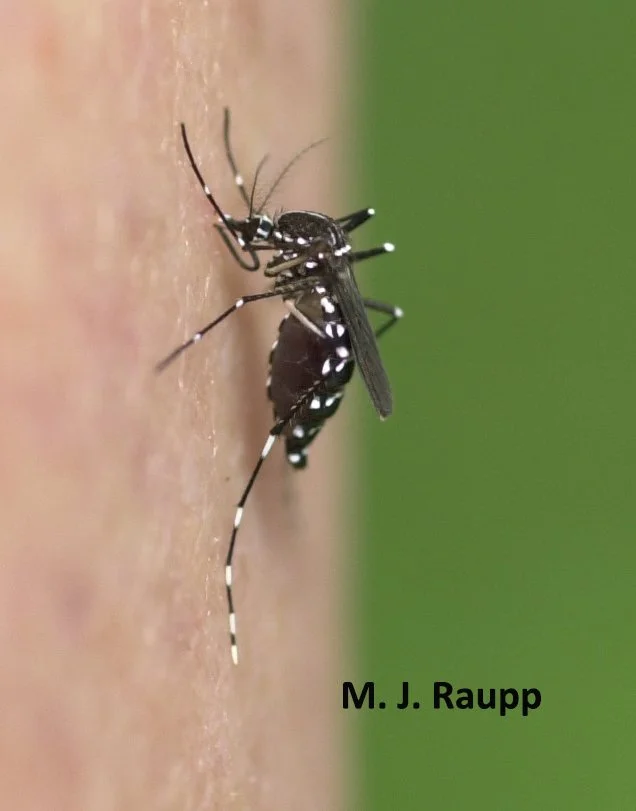
Asian tiger mosquitos are active during daylight hours. They vector important human diseases including dengue, chikungunya, and Zika.

If you dine outdoors, place a fan on your patio. The light breeze created by the fan will greatly reduce the number of mosquitoes flying and biting. Many traps are also available to capture and kill mosquitoes. Some rely on a light source to attract blood seekers. However, many types of moths, flies, and beetles are attracted to light. Mosquitoes, unfortunately, do not use light to find their meals and are not readily attracted to light traps. One study demonstrated that less than 1% of the insects attracted to light traps were biting flies such as mosquitoes. This study estimated that light traps kill billions of harmless and beneficial insects each year. Blood seeking mosquitoes are actually attracted to odors emanating from the host. As we move about the earth, we release many odors, including carbon dioxide and lactic acid, that are used by hungry mosquitoes to find us. Some mosquito traps release carbon dioxide and will catch many mosquitoes. Female mosquitoes ready to lay eggs are attracted to odors emanating from water sources. A clever trap called a Gravid Aedes Trap (GAT) has been used in community-wide programs in the DMV to reduce local populations of Asian Tiger mosquitoes. Females fly into these traps to lay eggs but never escape. Sounds like Hotel California for these tiny vampires.

 A garbage pail lid full of water becomes the perfect nursery for a crop of Culex mosquitoes. Two egg rafts contain scores of eggs ready to hatch. Nearby, fleets of mosquito larvae called wrigglers filter tiny particles of food from the water. In just a few short weeks, this lid will be bustling with fully developed wrigglers suspended beneath the water by breathing siphons. Amidst the milieu, zany mosquito pupae called tumblers bumble about. With continued hot weather and ample rainfall, adults will emerge, and yes, there will be blood.

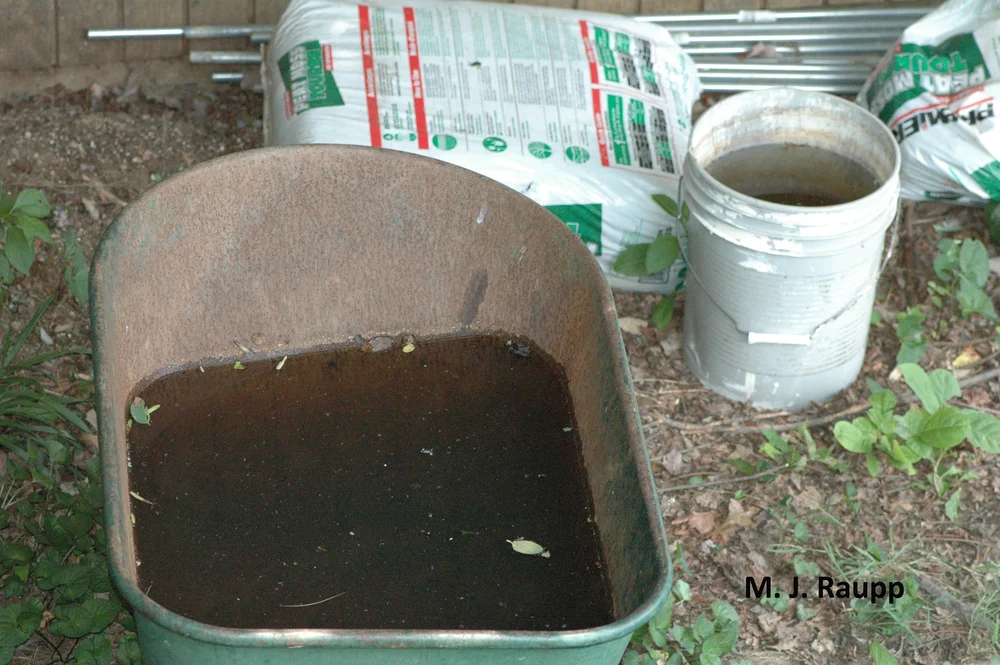
To reduce the chances of mosquitoes breeding around your home, eliminate standing water by cleaning your gutters, dumping your bird bath twice a week, inverting your wheelbarrow, and getting rid of water filled containers. If you have an aquatic water garden or standing water on your property that breed mosquitoes, you can use a product containing the naturally occurring soil microbe known as Bacillus thuringiensis israelensis a.k.a. Bti. Bti comes formulated in doughnut-shaped tablets that can be placed in water to kill mosquito larvae. With continued hot weather and ample rainfall, mosquitoes will be present for several more months. Be on the lookout and take precautions now to avoid being bitten.”     

Wheelbarrows and pails full of water – dump them now! They are nurseries for mosquito larvae.

Acknowledgements

We thank Dr. Megan Fritz for loaning us one Culex mosquito to record feeding on blood. Several interesting articles were consulted for this episode including, “How the body rubs out West Nile virus” by  Nathan Seppa, “Toll-like Receptor 7 Mitigates Lethal West Nile and Encephalitis via Interleukin 23-Dependent Immune Cell Infiltration and Homing” by Terrence Town, Fengwei Bai, Tian Wang, Amber T. Kaplan, Feng Qian, Ruth R. Montgomery, John F. Anderson, Richard A. Flavell, and Erol Fikrig, “Density and diversity of non-target insects killed by suburban electric insect traps” by Timothy B. Frick and Douglas W. Tallamy, “Neighbors help neighbors control urban mosquitoes” by Brian J. Johnson, David Brosch, Arlene Christiansen, Ed Wells, Martha Wells, Andre F. Bhandoola, Amy Milne, Sharon Garrison & Dina M. Fonseca, and “Mosquito days’ are on the rise, courtesy of global warming” courtesy of the Carey Institute of Ecosystem Studies. Information on the geographical and seasonal occurrences of West Nile Virus came from the data rich CDC websites. 

To learn more about the mosquitoes and how to defeat them, please view the following video:  https://youtu.be/mSRw4MnHaX8

This post appeared first on Bug of the Week
(877) 959-3534