Destination: Eastern North America to revisit Jorō spiders, Trichonephila clavata, spreading in their new home in the United States
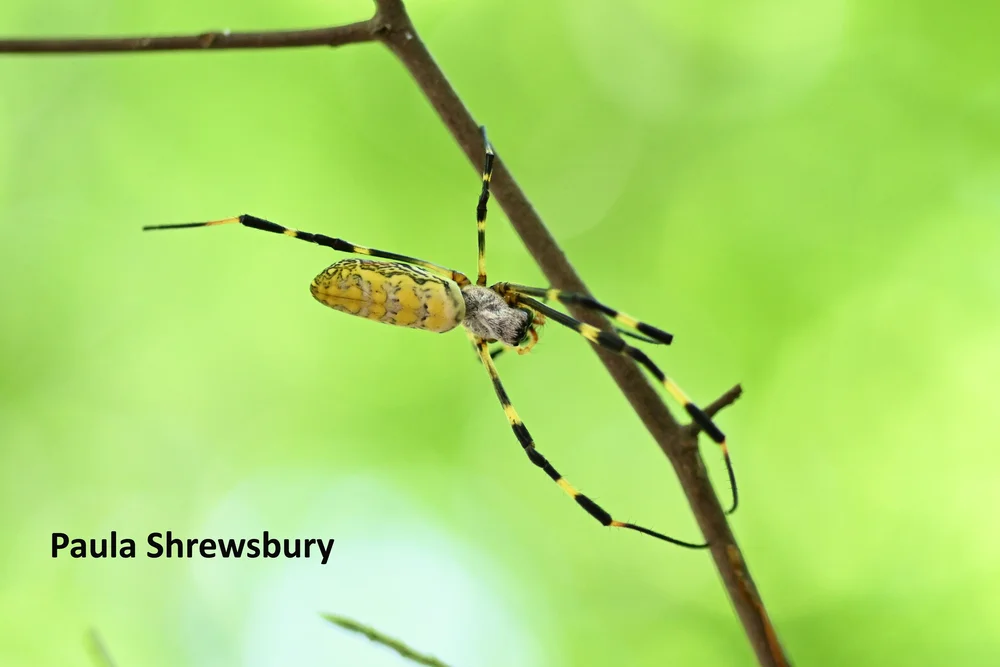
This is just one of the lovely Jorō spiders that now call Maryland home. Image credit: Paula Shrewsbury, UMD
This week we return from Central America, where we met one of the largest cockroaches on earth, to the US where we will revisit one of the largest spiders on earth, the Jorō spider. Jorō made headlines last week with reports that “Spiders the size of a human hand” were continuing their spread in the US. Bug of the Week first visited the Jorō spider in March of 2022 and wondered if there was any chance that it would make its way to the DMV. Little did we know that in September of 2022 two observations of Jorō spiders in eastern Howard County would be reported to iNaturalist. Three years and some four dozen sightings later, we know that Jorō spiders are happy and doing just fine in several locations in Maryland. The recent discoveries of Jorō spiders thriving in Maryland confirms a prognostication made by scientists Davis and Frick that physiological plasticity might allow Jorō spiders to escape the relative warmth of areas it has invaded in the southeastern US and expand its range northward along the eastern seaboard. With Jorō spiders merely 20 minutes away from home, how could one resist the opportunity to visit these amazing predators? The tales of how Jorō spiders and their cousin, the golden silk spider, arrived in the US can be found in previous episodes posted in 2022 and 2024.
Last year I visited Jorō spiders in Howard County, Maryland, and was surprised to discover several webs in a dense secondary forest. Several other species of large native orb weavers often create webs in more open flyways where victims are on the wing. Will these giants withstand the rigors of urban life as they establish more broadly across our land? Observations of Jorō in suburbs and cities are already well documented in several southern states. Fascinating studies by Andrew Davis and his colleagues found Jorō spiders to be more tolerant to environmental disturbances than other large native orb weavers. This could enhance their ability to thrive in busy urban locations. However, they discovered that spiders building webs near busy roadways may be slightly less likely to detect and attack prey due to disruptive auditory and visual cues. Bottom line, don’t be surprised to see Jorō in a neighborhood near you.
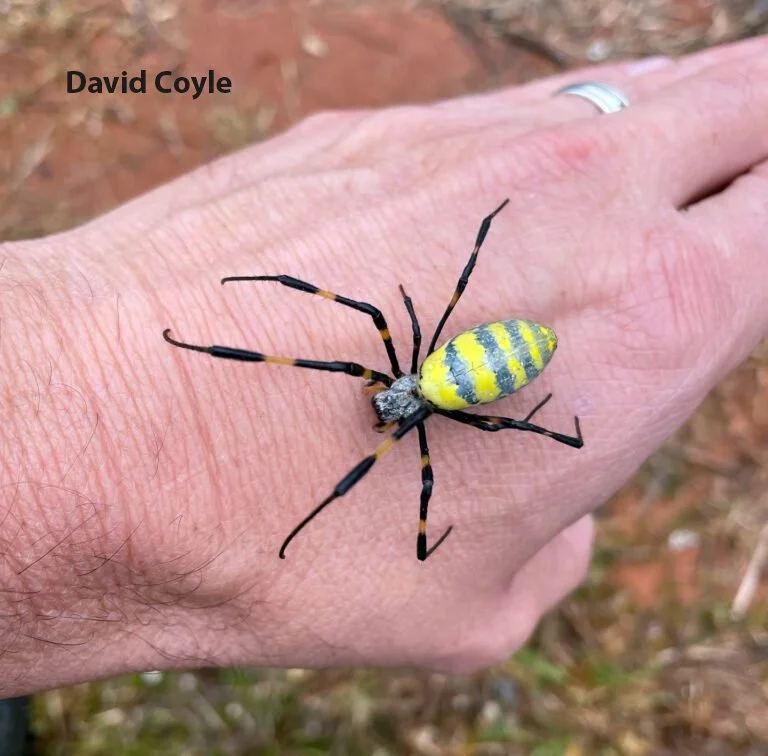
Despite what you may have heard, the Jorō spider is docile and poses no known threat to humans or pets. Image credit: David Coyle
To reduce some angst associated with a large non-native spider establishing near you, here are a few things you should know. The bite of the “venomous” Jorō spider will be terrible and painful, right? Nah, according to expert Rick Hoebeke, the risks to humans and pets are small due to the puny size of Jorō’s fangs which are unlikely to pierce our skin. Jorō spider expert Andrew Davis provided these calming words in a recent interview “This spider is not going to harm people, and it’s only going to hurt you if you try to pick it up.” As you will see in this week’s video, a large Jorō female was completely non-aggressive when I played with her. Rather than attack, she simply scampered across my hand.
A secondary forest in eastern Howard County has been colonized by Jorō spiders. Their haphazard webs are littered with remains of former victims, leaves, and shed exoskeletons. The much larger female Jorō spider dwarfs her mate, positioned just above her. See if you can spot a strand of silk produced by the spinnerets on the underside of her abdomen near the red mound. Relative to my hand you see how large and how docile Jorō is. In addition to forests, Jorō spiders thrive in urban and suburban areas. We will wait and see what the Jorō spider means to ecosystems here in the DMV. Maybe they will help other spiders put a beat-down on invasive pests like stink bugs and spotted lanternflies. Video by Mike Raupp and Paula Shrewsbury
These spiders are patient hunters that build enormous webs, larger than a meter in diameter, to capture prey snared by the silk. For arachnophobes these may be scary but for arachnophiles these are beautiful spiders which may provide important ecosystem services, including biological control of crop pests such as brown marmorated stink bugs or spotted lanternflies, with which they have an ancient association in their native range in Asia. Jorō spiders may be likened to Hannibal Lecter “having an old friend over for dinner” when they reunite with the stink bug or lanternfly here in the US. Large spiders like these may also become juicy prey items for feathered and non-feathered reptiles.
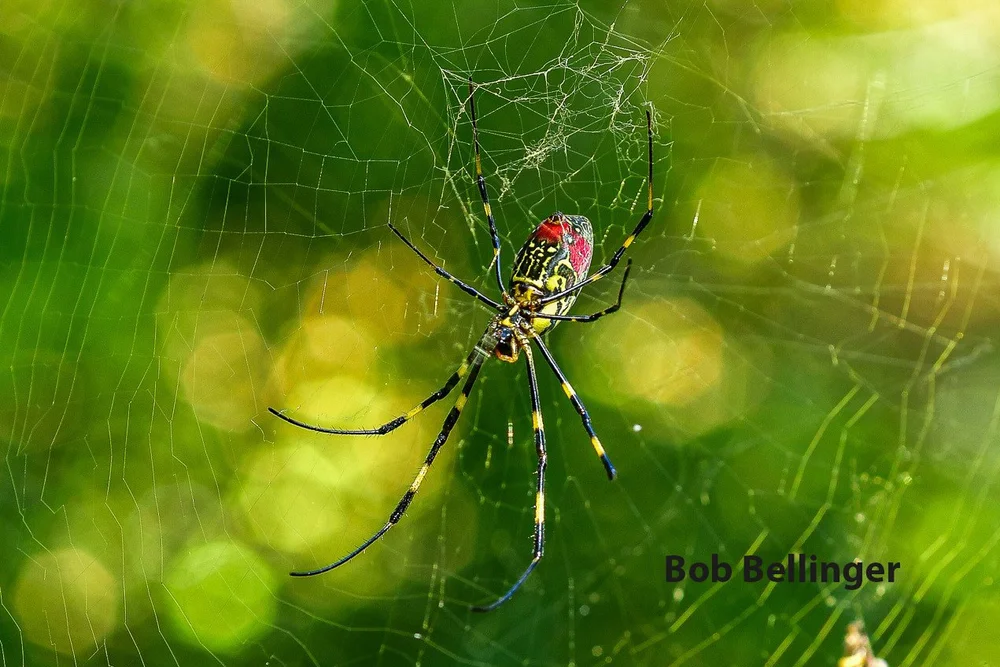
The underside of the Jorō spider has striking red markings. Image credit: Bob Bellinger
As with all non-native species that arrive in our land, it is difficult to predict what impact they will have on our ecosystems, but experts suggest that beyond their somewhat scary mien they may give our indigenous large orb weavers like the black and yellow garden spider, marbled orb weaver, and spotted orb weaver a run for their money. In locations in other parts of the world where Jorō is established, it often becomes the most abundant and dominant orb weaver. What will it mean for our resident spiders and their ecosystems? Only time will tell.
One final tidbit about Jorō comes from Japanese folklore. Jorō is a shapeshifter known as Jorō -gumo. Jorō-gumo turns into a beautiful woman, seduces men, binds them with silk, and devours them. Yikes! Sounds like a bad date to me.
Acknowledgements
Bug of the Week thanks Rick Hoebeke for identifying Jorō as it arrived in the US and for providing insights into the ways of these large, beautiful spiders. We also thank David Coyle and Bob Bellinger for sharing great images and knowledge of Jorō. Fascinating studies entitled “Veni, vidi, vici? Future spread and ecological impacts of a rapidly expanding invasive predator population” by David R. Nelsen, Aaron G. Corbit, Angela Chuang, John F. Deitsch, Michael I. Sitvarin and David R. Coyle, “Physiological evaluation of newly invasive Jorō spiders (Trichonephila clavata) in the southeastern USA compared to their naturalized cousin, Trichonephila clavipes” by Andrew K. Davis and Benjamin L. Frick, “Nephila clavata L Koch, the Joro Spider of East Asia, newly recorded from North America (Araneae: Nephilidae)” by E. Richard Hoebeke, Wesley Huffmaster, and Byron J Freeman, “The Life Cycle, Habitat and Variation in Selected Web Parameters in the Spider, Nephila clavipes Koch (Araneidae)” by Clovis W. Moore, “Startle responses of jorō spiders (Trichonephila clavata) to artificial disturbance’ by Andrew K. Davis and A. Anerao, and “How Urban-Tolerant Are They? Testing Prey–Capture Behavior of Introduced Jorō Spiders (Trichonephila clavata) Next to Busy Roads” by Andrew K. Davis, Kade Stewart, Caitlin Phelan and Alexa Schultz, provided the inspiration for this story and details surrounding the stars of this episode. We thank Dr. Dave Clement, Miri Talabac, and Maddie Potter for hooking us up with the colony of Jorō spiders.
To see other large orb weavers and differentiate them from the Jorō spider, please click on this link: https://resources.ipmcenters.org/view/resource.cfm?rid=27877
To hear more about the Jorō spider and calm your fears about it, please click on this link to Jorō guru David Coyle’s take on this spider: https://youtu.be/zhO_bwwg-E4?si=nhd9au-t-HRCmw6b
This post appeared first on Bug of the Week
